
“Jay Kelly is a film made by movie lovers for movie lovers.”
That’s the first thing that struck me. Many critics approached it through the lens of celebrity satire or midlife crisis drama, but for me, this is a filmmaker’s film — a work that understands the eternal debate at the heart of cinema: should a movie speak through images or through words?
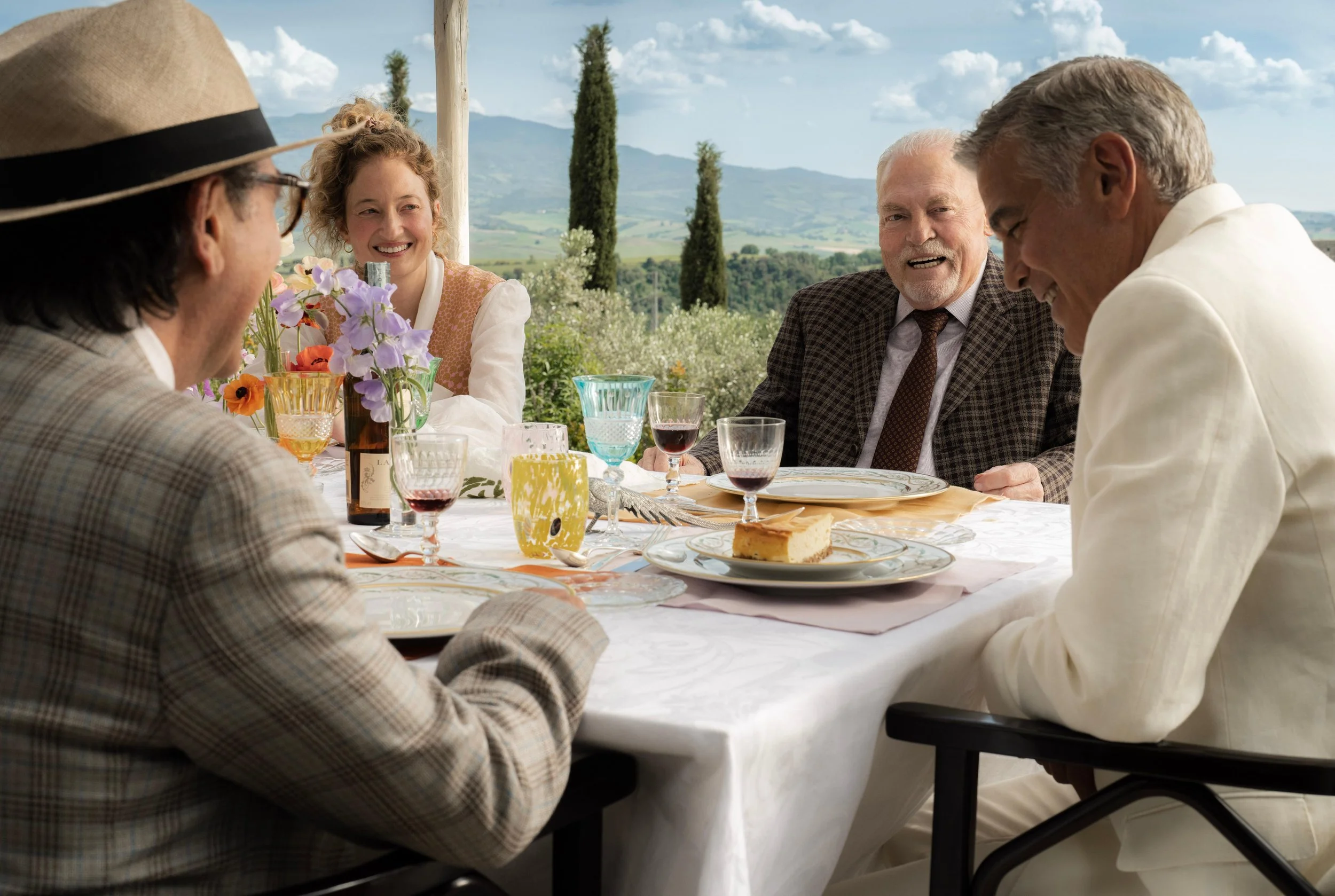
Jay Kelly scene in Tuscany
Some argue that too much dialogue turns a film into a stage play. Others defend the screenplay as the backbone of meaning. Jay Kelly doesn’t pick a side — it embraces both. Baumbach and Emily Mortimer fill the film with dialogue that feels lived-in, but always let the scenes, the textures, the silences, and even the awkwardness carry the emotional weight. It’s a reminder that cinema is built from moments first, lines second.
The film is also sprinkled with love letters to the history of movies. Not just the posters and portraits plastered on walls, but the names dropped, the references hidden in framing, and the stylistic nods that echo the greats. Watching it, I felt touches of Kiarostami’s playfulness in Certified Copy, John Ford’s observational patience, and Bergman’s philosophical quiet. Baumbach wants you to notice — not because he’s showing off, but because he’s inviting you into the same library of influences that shaped him.
He makes this clear right from the opening. By starting inside a studio — showing the machinery of illusion — he isn’t breaking the magic. He’s saying, “Come dream with me. Let’s remember what movies can do.”
Then he places a superstar on a regular train, shoulder-to-shoulder with everyday people. It’s a simple choice, but it feels like a warm gesture to the audience: “You too. You’re part of this story. Climb aboard.”
The sex scene is another perfect example. Stripped of glamour, chemistry, and cinematic seduction, it plays out with almost zero erotic appeal. Because that’s the point. Baumbach is reminding us that real life rarely behaves like the movies — and sometimes that honesty is funnier and more touching than any glossy fantasy.
But beneath all of this cinephile charm, the film holds a quiet truth we all face: our lives are shaped by the choices we make, one after another, with no rewinds and no alternate versions to compare. There is no “what if.” There is only the path we walked.
It is what it is.
And the film looks at that reality with tenderness rather than tragedy.
For me, that’s why Jay Kelly works. It’s not just a story about a fading star or a commentary on fame; it’s a reflection on filmmaking, on life, and on the strange, sometimes beautiful intersection between the two.